Join the Facebook group here
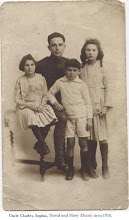
With the outbreak of the nineteen fourteen to eighteen war, foreigners were regarded with deep suspicion. Simon Dunn’s half brother Charles joined up the serve in the U.S. army. Charles’s presence in the army can be noted from a portraity of him and three of the Dunn siblings, taken around 1918. In the photograph Simon’s brother Charles is seen surrounded by his nieces and nephew Sophia, David and Mary (or Frances?) He is dressed in American military uniform of the World War One era, defined in detail by his shoulder epaulettes, trouser garters and boots or footwear. They would be quite typical of the period. His youngest nephew David would appear to be aged eight or nine, which fits the time frame nicely, as his birth date was the 13th June, 1911.
Charles who emigtated to the U.S.A. in 1906 had two other brothers Harry Edward Dunn and David and two sisters, Rose Dunn and Ada. Charles was born in 1889, in Lithuania/Russia. Harry, born in 1888, emigrated to New York in 1905 and married Mollie . Her maiden name is not known. The census from 1920 shows him working as a Clerk, and later confectionary wholesale dealer in Manhattan, the Jewish quarter of the sprawling Metropolis. By 1930, the couple had three children, Sarah born around 1915, Mildred, 1923 and Leore,1925. Mollie who was born around 1893is listed no occupation, meaning she was probably a housewife, quite typically of the period. Harry's occupation is given as "retail merchant, confectionary".
Harry's sister, Rose would also come to The Big Apple around this time. She, like her brothers and sister was from Kaisierdorys in Lithuania's Vilna district. She was nineteen when she made her journey, being born in or around 1894. She had stopped off in England before setting sail for America, at least in Southampton, where her ship departed from. She was a dressmaker by occupation and was not married by this point. Her mother is listed as S. Dunn, but strangly her father is given as Henrich Feckner. It is perhaps plausible to assume that he was her Step-Father and that her biological father, Emanuel Dunn had by this time passed away. He was after all, already 45 in the 1890's by the time of his third marriage, which was to the unamed girl of nineteen. We can only name her as the aforementioned S. Dunn. A guess as to her first name would be Sarah or Sofia. Since Harry Dunn named his first child Sarah, that seems a plausible name for his mother. She lived to be nearly a hundred, being born in or around 1869. Aunty Mary remarked that she remembers her father telling her that his stepmother, i.e. his half-sibling's mother did not treat him very well, so he ran away from home. He then connected up with them years later.
Click here to join the facebook group, "Descendants of Emanuel Don".
Thursday, 20 May 2010


Tuesday, 10 November 2009
Bella Dunn and The 1901 Census...


Have you ever heard of Bella Dunn? Well I certainly hadn't until discovering her name on the 1901 Census. It seem's she was the tragically ill fated second child of Simon and Rebecca. She is listed as an infant on the census, aged about 1. Sadly however she died by June 1901, as her death is recorded in the period of April-May-June of the 1901 registration of deaths for England and Wales.
Perhaps the loss of their second baby, in an area of east London known to be riddled with filth, squallar and disease was the catalyst which pushed our ancestors to make a better life for themselves in the cool, crisp, purer air of Puntas Arenas...
The Dunn's of Dunk Street

This map of Whitechapel, in the East End of London would have been a familiar layout to the Whitechapel Simon, Rebecca and family knew for a few years before they set sail for Chile. They lived at number 14 Dunk Street, at the time of the 1901 census.

Monday, 26 October 2009


Sunday, 25 October 2009

Subscribe to:
Posts (Atom)