A family reunion has been booked in a central London venue near Marble Arch, for Sunday 24th July 2011. It is for several first cousins, whose parents were all born a Dunn, (the sons and daughters of Simon and Rebecca) their partners as well as honoury Romanofsky-Poirier descendants. Other family members are of course welcome but I need to know numbers in advance to plan for catering.
For more details email me personally.
Wednesday, 6 April 2011


Tuesday, 5 April 2011
Klezmer Klub: Yiddish songs from London's East End
London based Yiddish song revivalists Klezmer Klub perfectly encapsulate the lost life and spirit of a time and place long since passed. Their second album "Whitechapel Mayn Vaytshepel" cuts a cross section through the musical back alleys and main streets of a Whitechapel in London's Jewish East End, rich with the aroma of freshly cooked bagels and fetid with the stench of rancid, rotting fish. A world of bustling cobbled streets, heaving with optimistic, yet poor and lowly Eastern European immigrants. Hopes and aspirations dashed by the harsh realities of life in the sly and often sordid big city. Tales of a vanished streetscape abound on this collection of songs, sung by Yiddish language revivalist Vivi Lachs, while backed by an energetic ensemble of technically proficient Klezmatists.
It turns out that Vivi's grandfather who worked for the London shechita board, koshering cows and chickens, lived over the road to Simon and Rebecca Dunn, at number 13 Dunk Street, though not necessarily at the same time.
http://www.myspace.com/klezmerklub
http://m.youtube.com/#/watch?xl=xl_blazer&v=wbFN9txT1AI
It turns out that Vivi's grandfather who worked for the London shechita board, koshering cows and chickens, lived over the road to Simon and Rebecca Dunn, at number 13 Dunk Street, though not necessarily at the same time.
http://www.myspace.com/klezmerklub
http://m.youtube.com/#/watch?xl=xl_blazer&v=wbFN9txT1AI
Thursday, 31 March 2011
About the town of Kaisiadorys
Kaisiadorys (Koshedar)
Written by Yosef Rosin
English edited by Sarah and Mordechai Kopfstein
Koshedar (in Yiddish), 24 km south-east of Kovno, developed in the second half of the 19th century when the Kovno-Vilna railway line was constructed and a station was built there. Later, when the Koshedar- Siauliai railway line was built, the town became an important and busy railway junction.
Until 1795 Koshedar was part of the Polish-Lithuanian Kingdom, when the third division of Poland by the three superpowers of those times - Russia, Prussia and Austria - caused Lithuania to become partly Russian or Prussian. The part of Lithuania which included Koshedar fell under the rule of Czarist Russia. From 1802 it was part of the Vilna province (Gubernia) as a county center.
During independent Lithuania (1918-1940) Koshedar continued to be a county center, and as a result of Poland’s occupation of Vilna and its region, which included the town Trok (Trakai), Koshedar also served as the center of the Trakai district. During this period the importance of Koshedar decreased because, according to the new border with Poland, the railway connection to Poland and Russia ceased to exist.
Jewish Settlement till World War II
Jews settled in Koshedar while the railway station was being built. The first Jewish families - David Tekatch, Shemuel Morgenshtern, Khayim Strashun and Yakov Khayuth (Khayes) - settled near the station and made their living in timber, while their wives kept hotels, restaurants and bars. Jews who arrived later built their houses in the town itself, some 2 km from the station.
By 1897 there were 833 residents in Koshedar, of them 317 Jews (38%).
About 60 Jewish families, whose economic situation was solid, lived in Koshedar before WW1. They had a Beth-Midrash and employed a Rabbi, a Shokhet and a Mohel. The children studied in a "Kheder Metukan" (Improved Kheder). There was also a library.
Zionism gained support in Koshedar, and at the regional conference of the "Zionist Associations" of the Kovno and Vilna Gubernias, which took place in Vilna in 1898 with the participation of 71 delegates from 51 cities and towns, the delegate from Koshedar was the local Rabbi Tsevi Hurvitz. The list of donors for the settlement of Eretz-Yisrael, published in the Hebrew newspaper "HaMeilitz" in the years 1893-1899, contains 74 names of Koshedar Jews. The fund raisers were Rabbi Tsevi Hurvitz, Mosheh Gelvan and Shelomoh Tekatch. The correspondents for "HaMeilitz" were Yosef Fraker and D.Zak.
After the establishment of independent Lithuania in 1918, and following the autonomy law for minorities issued by the new Lithuanian government, the Minister for Jewish Affairs, Dr. Menachem (Max) Soloveitshik, ordered elections to be held for community committees (Va'ad Kehilah) in the summer of 1919. In Koshedar the elections took place in autumn 1919 and a committee of 9 members was elected: 2 General Zionists, 3 from the artisans, 4 undefined. This committee was active in almost all fields of Jewish life until the end of 1925, after which the autonomy was annulled.
At the elections for the first Lithuanian Seimas (Parliament) in October 1922, the Zionist list in Koshedar received 139 votes, the Democrats-23 and "Akhduth"-16.
According to the first census performed by the government in 1923, Koshedar had 1929 residents, of them 596 Jews (31%).
During this period the local Jews made their living from commerce, crafts and light industry. According to the government survey of 1931 there were 20 businesses, including 15 owned by Jews (75%).
Details according to the type of business are given in the table below:
Type of the business
Total
Owned by Jews
Groceries
1
1
Butcher's shops and Cattle Trade
4
1
Restaurants and Taverns
7
6
Beverages
1
1
Textile Products and Furs
2
2
Medicine and Cosmetics
1
1
Radio, Sewing Machines and Electric Equipment
1
1
Timber and Heating Material
1
1
Machines and Transportation 1
0
Miscellaneous
1
1
According to the same survey, Koshedar had 11 light industry factories, 9 of them owned by Jews (82%), as can be seen in the following table:
Type of the Factory Total
Jewish owned
Metal Workshops, Power Plants
1
0
Chemical Industry: Lubrication Ointment
1
1
Textile: Wool, Flax, Knitting
1
1
Food: Flour Mills, Bakeries
3
3
Sawmills, Furniture
1
1
Furs, Hats
4
3
By 1937 there were 27 Jewish artisans: 6 tailors, 5 butchers, 3 bakers,
3 barbers, 2 shoemakers, 2 stitchers, 1 glazier, 1 book binder, 1 blacksmith, 1 tinsmith, 1 painter, 1 saddler.
The Jewish Folksbank played an important role in the economic life of Koshedar’s Jews. In 1927 it had 170 members, but in the thirties the number of its members decreased to 110. In 1939 there were 64 phones in town, 7 of them belonging to Jews.
The deterioration of Koshedar as a railway junction to Vilna and eastwards and the economic crisis in Lithuania caused many Koshedar Jews to immigrate to America, South Africa and Uruguay. Some immigrated to Eretz-Yisrael. At the end of the thirties only about 60 Jewish families were left in Koshedar, who subsisted mainly from the two weekly market days.
Koshedar Hebrew Elementary School 1936
Jewish children, numbering a yearly average of about 40 pupils, studied in the Hebrew school of the "Tarbuth" chain. Several graduates of this school continued their studies in the Hebrew High Schools in Kovno. There was a "Kheder" with 15 boys, and also a Yiddish library of the "Libhober fun Vissen" (Seekers of Knowledge) association.
Many belonged to the Zionist movement, and all Zionist parties had representatives in town.
Zionist youth organizations in Koshedar included "HaShomer HaTsair", "Beitar" etc. Sports activities took place in the "Maccabi" branch with about 40 members, while there was also the "Tifereth-Bakhurim" organization for religious boys.
Religious life in Koshedar concentrated around the Beth-Midrash where lessons were given by the Tehilim society, the Mishnah society and the Shas (Talmud) society.
Among the Rabbis who served in Koshedar were:
Binyamin Meizel (from 1881)
Tsevi-Hirsh Hurvitz (in Koshedar 1890-1902)
Yisrael-Aba Kriger (from 1903)
Shalom-Yitskhak Shtchupak, (served 1922-1929)
Aharon-David Yafe, its last Rabbi (served 1934-1941), was murdered in 1941.
Among the personalities born in Koshedar were: Moris Gest (Gershonovitz 1881-1942), who immigrated to America at the age of 12. He was an impresario who brought famous artists from Europe to America and cooperated with Reinhardt in the direction of the play "The Miracle"; Rabbi Yosef Kanovitz (1878-?), who served in several towns in Lithuania, and lived in America from 1915, where he served as Rabbi in several cities in N.J. and N.Y. states.
Written by Yosef Rosin
English edited by Sarah and Mordechai Kopfstein
Koshedar (in Yiddish), 24 km south-east of Kovno, developed in the second half of the 19th century when the Kovno-Vilna railway line was constructed and a station was built there. Later, when the Koshedar- Siauliai railway line was built, the town became an important and busy railway junction.
Until 1795 Koshedar was part of the Polish-Lithuanian Kingdom, when the third division of Poland by the three superpowers of those times - Russia, Prussia and Austria - caused Lithuania to become partly Russian or Prussian. The part of Lithuania which included Koshedar fell under the rule of Czarist Russia. From 1802 it was part of the Vilna province (Gubernia) as a county center.
During independent Lithuania (1918-1940) Koshedar continued to be a county center, and as a result of Poland’s occupation of Vilna and its region, which included the town Trok (Trakai), Koshedar also served as the center of the Trakai district. During this period the importance of Koshedar decreased because, according to the new border with Poland, the railway connection to Poland and Russia ceased to exist.
Jewish Settlement till World War II
Jews settled in Koshedar while the railway station was being built. The first Jewish families - David Tekatch, Shemuel Morgenshtern, Khayim Strashun and Yakov Khayuth (Khayes) - settled near the station and made their living in timber, while their wives kept hotels, restaurants and bars. Jews who arrived later built their houses in the town itself, some 2 km from the station.
By 1897 there were 833 residents in Koshedar, of them 317 Jews (38%).
About 60 Jewish families, whose economic situation was solid, lived in Koshedar before WW1. They had a Beth-Midrash and employed a Rabbi, a Shokhet and a Mohel. The children studied in a "Kheder Metukan" (Improved Kheder). There was also a library.
Zionism gained support in Koshedar, and at the regional conference of the "Zionist Associations" of the Kovno and Vilna Gubernias, which took place in Vilna in 1898 with the participation of 71 delegates from 51 cities and towns, the delegate from Koshedar was the local Rabbi Tsevi Hurvitz. The list of donors for the settlement of Eretz-Yisrael, published in the Hebrew newspaper "HaMeilitz" in the years 1893-1899, contains 74 names of Koshedar Jews. The fund raisers were Rabbi Tsevi Hurvitz, Mosheh Gelvan and Shelomoh Tekatch. The correspondents for "HaMeilitz" were Yosef Fraker and D.Zak.
After the establishment of independent Lithuania in 1918, and following the autonomy law for minorities issued by the new Lithuanian government, the Minister for Jewish Affairs, Dr. Menachem (Max) Soloveitshik, ordered elections to be held for community committees (Va'ad Kehilah) in the summer of 1919. In Koshedar the elections took place in autumn 1919 and a committee of 9 members was elected: 2 General Zionists, 3 from the artisans, 4 undefined. This committee was active in almost all fields of Jewish life until the end of 1925, after which the autonomy was annulled.
At the elections for the first Lithuanian Seimas (Parliament) in October 1922, the Zionist list in Koshedar received 139 votes, the Democrats-23 and "Akhduth"-16.
According to the first census performed by the government in 1923, Koshedar had 1929 residents, of them 596 Jews (31%).
During this period the local Jews made their living from commerce, crafts and light industry. According to the government survey of 1931 there were 20 businesses, including 15 owned by Jews (75%).
Details according to the type of business are given in the table below:
Type of the business
Total
Owned by Jews
Groceries
1
1
Butcher's shops and Cattle Trade
4
1
Restaurants and Taverns
7
6
Beverages
1
1
Textile Products and Furs
2
2
Medicine and Cosmetics
1
1
Radio, Sewing Machines and Electric Equipment
1
1
Timber and Heating Material
1
1
Machines and Transportation 1
0
Miscellaneous
1
1
According to the same survey, Koshedar had 11 light industry factories, 9 of them owned by Jews (82%), as can be seen in the following table:
Type of the Factory Total
Jewish owned
Metal Workshops, Power Plants
1
0
Chemical Industry: Lubrication Ointment
1
1
Textile: Wool, Flax, Knitting
1
1
Food: Flour Mills, Bakeries
3
3
Sawmills, Furniture
1
1
Furs, Hats
4
3
By 1937 there were 27 Jewish artisans: 6 tailors, 5 butchers, 3 bakers,
3 barbers, 2 shoemakers, 2 stitchers, 1 glazier, 1 book binder, 1 blacksmith, 1 tinsmith, 1 painter, 1 saddler.
The Jewish Folksbank played an important role in the economic life of Koshedar’s Jews. In 1927 it had 170 members, but in the thirties the number of its members decreased to 110. In 1939 there were 64 phones in town, 7 of them belonging to Jews.
The deterioration of Koshedar as a railway junction to Vilna and eastwards and the economic crisis in Lithuania caused many Koshedar Jews to immigrate to America, South Africa and Uruguay. Some immigrated to Eretz-Yisrael. At the end of the thirties only about 60 Jewish families were left in Koshedar, who subsisted mainly from the two weekly market days.
Koshedar Hebrew Elementary School 1936
Jewish children, numbering a yearly average of about 40 pupils, studied in the Hebrew school of the "Tarbuth" chain. Several graduates of this school continued their studies in the Hebrew High Schools in Kovno. There was a "Kheder" with 15 boys, and also a Yiddish library of the "Libhober fun Vissen" (Seekers of Knowledge) association.
Many belonged to the Zionist movement, and all Zionist parties had representatives in town.
Zionist youth organizations in Koshedar included "HaShomer HaTsair", "Beitar" etc. Sports activities took place in the "Maccabi" branch with about 40 members, while there was also the "Tifereth-Bakhurim" organization for religious boys.
Religious life in Koshedar concentrated around the Beth-Midrash where lessons were given by the Tehilim society, the Mishnah society and the Shas (Talmud) society.
Among the Rabbis who served in Koshedar were:
Binyamin Meizel (from 1881)
Tsevi-Hirsh Hurvitz (in Koshedar 1890-1902)
Yisrael-Aba Kriger (from 1903)
Shalom-Yitskhak Shtchupak, (served 1922-1929)
Aharon-David Yafe, its last Rabbi (served 1934-1941), was murdered in 1941.
Among the personalities born in Koshedar were: Moris Gest (Gershonovitz 1881-1942), who immigrated to America at the age of 12. He was an impresario who brought famous artists from Europe to America and cooperated with Reinhardt in the direction of the play "The Miracle"; Rabbi Yosef Kanovitz (1878-?), who served in several towns in Lithuania, and lived in America from 1915, where he served as Rabbi in several cities in N.J. and N.Y. states.
Monday, 21 February 2011
Rose Dunn, Ellis Island entry, 1913

Rose Dunn's Last Will and Testament

A wealth of information on Lithuanian Jewish Dunn origins...
The website of Jose Gutstein, in Cuba gives a great abundance of useful information about the origins of Jewish Dunn's from Lithuania.
The following is from his page on the surname Don, which is a variation of Dunn...
"DON was the second most common surname in Zasliai (trailing only KATS). There are literally hundreds of records, from various sources, bearing the surname in this town. Below is a sample of them, including those found in the 1854 Revision List, as well as the 1878 Trakai District Alphabetical List of Male Names. Many DON's from Zasliai and nearby towns immigrated to America and went through Ellis Island, and that list is included below. Also, included is the list of Pages of Testimony filed at Yad Vashem for persons memorializing a DON from Zasliai and environs.
NOTE: If you are a DON from Zasliai, or anywhere nearby, including Kaisiadorys (Koshedar), Ziezmariai (Zezmer), Rumsiskes (Rumshishok), Trakai (Troki), or even Kovno or Vilna, please contact me so I can try to figure out how we'd be related. The vast majority of DON families in the region between Kovno and Vilna have connections to Zasliai, and, given the extraordinary amount of DON's in Zasliai compared to other towns, they likely originated in Zasliai."
The following is from his page on the surname Don, which is a variation of Dunn...
"DON was the second most common surname in Zasliai (trailing only KATS). There are literally hundreds of records, from various sources, bearing the surname in this town. Below is a sample of them, including those found in the 1854 Revision List, as well as the 1878 Trakai District Alphabetical List of Male Names. Many DON's from Zasliai and nearby towns immigrated to America and went through Ellis Island, and that list is included below. Also, included is the list of Pages of Testimony filed at Yad Vashem for persons memorializing a DON from Zasliai and environs.
NOTE: If you are a DON from Zasliai, or anywhere nearby, including Kaisiadorys (Koshedar), Ziezmariai (Zezmer), Rumsiskes (Rumshishok), Trakai (Troki), or even Kovno or Vilna, please contact me so I can try to figure out how we'd be related. The vast majority of DON families in the region between Kovno and Vilna have connections to Zasliai, and, given the extraordinary amount of DON's in Zasliai compared to other towns, they likely originated in Zasliai."
Thursday, 20 May 2010
The Descendants of Emanuel Don: Now a Facebook Group!
Join the Facebook group here
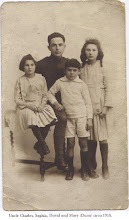
With the outbreak of the nineteen fourteen to eighteen war, foreigners were regarded with deep suspicion. Simon Dunn’s half brother Charles joined up the serve in the U.S. army. Charles’s presence in the army can be noted from a portraity of him and three of the Dunn siblings, taken around 1918. In the photograph Simon’s brother Charles is seen surrounded by his nieces and nephew Sophia, David and Mary (or Frances?) He is dressed in American military uniform of the World War One era, defined in detail by his shoulder epaulettes, trouser garters and boots or footwear. They would be quite typical of the period. His youngest nephew David would appear to be aged eight or nine, which fits the time frame nicely, as his birth date was the 13th June, 1911.
Charles who emigtated to the U.S.A. in 1906 had two other brothers Harry Edward Dunn and David and two sisters, Rose Dunn and Ada. Charles was born in 1889, in Lithuania/Russia. Harry, born in 1888, emigrated to New York in 1905 and married Mollie . Her maiden name is not known. The census from 1920 shows him working as a Clerk, and later confectionary wholesale dealer in Manhattan, the Jewish quarter of the sprawling Metropolis. By 1930, the couple had three children, Sarah born around 1915, Mildred, 1923 and Leore,1925. Mollie who was born around 1893is listed no occupation, meaning she was probably a housewife, quite typically of the period. Harry's occupation is given as "retail merchant, confectionary".
Harry's sister, Rose would also come to The Big Apple around this time. She, like her brothers and sister was from Kaisierdorys in Lithuania's Vilna district. She was nineteen when she made her journey, being born in or around 1894. She had stopped off in England before setting sail for America, at least in Southampton, where her ship departed from. She was a dressmaker by occupation and was not married by this point. Her mother is listed as S. Dunn, but strangly her father is given as Henrich Feckner. It is perhaps plausible to assume that he was her Step-Father and that her biological father, Emanuel Dunn had by this time passed away. He was after all, already 45 in the 1890's by the time of his third marriage, which was to the unamed girl of nineteen. We can only name her as the aforementioned S. Dunn. A guess as to her first name would be Sarah or Sofia. Since Harry Dunn named his first child Sarah, that seems a plausible name for his mother. She lived to be nearly a hundred, being born in or around 1869. Aunty Mary remarked that she remembers her father telling her that his stepmother, i.e. his half-sibling's mother did not treat him very well, so he ran away from home. He then connected up with them years later.
Click here to join the facebook group, "Descendants of Emanuel Don".
With the outbreak of the nineteen fourteen to eighteen war, foreigners were regarded with deep suspicion. Simon Dunn’s half brother Charles joined up the serve in the U.S. army. Charles’s presence in the army can be noted from a portraity of him and three of the Dunn siblings, taken around 1918. In the photograph Simon’s brother Charles is seen surrounded by his nieces and nephew Sophia, David and Mary (or Frances?) He is dressed in American military uniform of the World War One era, defined in detail by his shoulder epaulettes, trouser garters and boots or footwear. They would be quite typical of the period. His youngest nephew David would appear to be aged eight or nine, which fits the time frame nicely, as his birth date was the 13th June, 1911.
Charles who emigtated to the U.S.A. in 1906 had two other brothers Harry Edward Dunn and David and two sisters, Rose Dunn and Ada. Charles was born in 1889, in Lithuania/Russia. Harry, born in 1888, emigrated to New York in 1905 and married Mollie . Her maiden name is not known. The census from 1920 shows him working as a Clerk, and later confectionary wholesale dealer in Manhattan, the Jewish quarter of the sprawling Metropolis. By 1930, the couple had three children, Sarah born around 1915, Mildred, 1923 and Leore,1925. Mollie who was born around 1893is listed no occupation, meaning she was probably a housewife, quite typically of the period. Harry's occupation is given as "retail merchant, confectionary".
Harry's sister, Rose would also come to The Big Apple around this time. She, like her brothers and sister was from Kaisierdorys in Lithuania's Vilna district. She was nineteen when she made her journey, being born in or around 1894. She had stopped off in England before setting sail for America, at least in Southampton, where her ship departed from. She was a dressmaker by occupation and was not married by this point. Her mother is listed as S. Dunn, but strangly her father is given as Henrich Feckner. It is perhaps plausible to assume that he was her Step-Father and that her biological father, Emanuel Dunn had by this time passed away. He was after all, already 45 in the 1890's by the time of his third marriage, which was to the unamed girl of nineteen. We can only name her as the aforementioned S. Dunn. A guess as to her first name would be Sarah or Sofia. Since Harry Dunn named his first child Sarah, that seems a plausible name for his mother. She lived to be nearly a hundred, being born in or around 1869. Aunty Mary remarked that she remembers her father telling her that his stepmother, i.e. his half-sibling's mother did not treat him very well, so he ran away from home. He then connected up with them years later.
Click here to join the facebook group, "Descendants of Emanuel Don".
Subscribe to:
Posts (Atom)